Austin, TX area, Instrumentation · Research

Raymond Lee

Instrumentation and Research Engineer — atomic sensing, experimental controls, and test systems

Research engineer with hands-on experience building scientific instrumentation, data-acquisition software, and experimental controls for atomic magnetometers and trapped-ion systems. Uses LabVIEW, Python, and NI-DAQ to operate instruments, analyze data, and support precision measurements. Co-author of peer-reviewed work in through-barrier electromagnetic-induction imaging and Doppler cooling. Targeting instrumentation, test, and research-engineering roles in aerospace, defense, sensing, and related R&D.

Section 01

Experience

  1. –

    Voluntary post-M.S. research, atomic-magnetometer EMI imaging

    University College London — Laser Cooling Laboratory

    Continued EMI imaging; two-photon transition work for portable sensor sensitivity / sub-mm detection; co-authored IEEE TIM 2025.
  2. –

    M.S. thesis research, atomic-magnetometer EMI imaging

    University College London — Laser Cooling Laboratory

    Designed/refined high-precision atomic-magnetometer setups under Prof. Ferruccio Renzoni; LabVIEW for instrument control; Python for diagnostic, calibration, analysis, visualization.
  3. –

    Undergraduate researcher

    University of Washington — Trapped Ion Quantum Computing Laboratory

    Python GUI + NI-DAQ for real-time instrument control; simulate Paul traps; built/calibrated ion-trapping apparatus; two-tone Doppler cooling; co-authored Phys. Rev. A 2022.
  4. –

    Undergraduate researcher

    University of Washington — QENS Research Group

    XRD, SEM, QENS for proton dynamics / structural behavior.
  5. –

    Software internship

    Web Application Developer internship

    GoGet.my · Kuala Lumpur

    HTML/CSS/JS, Ruby on Rails, maps APIs.
    Screenshot of the GoGet homepage.

Section 02

Projects

  • Oct 2022 – Jun 2024

    Atomic-magnetometer EMI imaging

    University College London — Laser Cooling Laboratory

    • M.S. thesis research, Oct 2022 – Sep 2023. Designed/refined high-precision atomic-magnetometer setups under Prof. Ferruccio Renzoni; LabVIEW for instrument control; Python for diagnostic, calibration, analysis, visualization.
    • Voluntary post-M.S. research, Oct 2023 – Jun 2024. Continued EMI imaging; two-photon transition work for portable sensor sensitivity / sub-mm detection; co-authored IEEE TIM 2025.
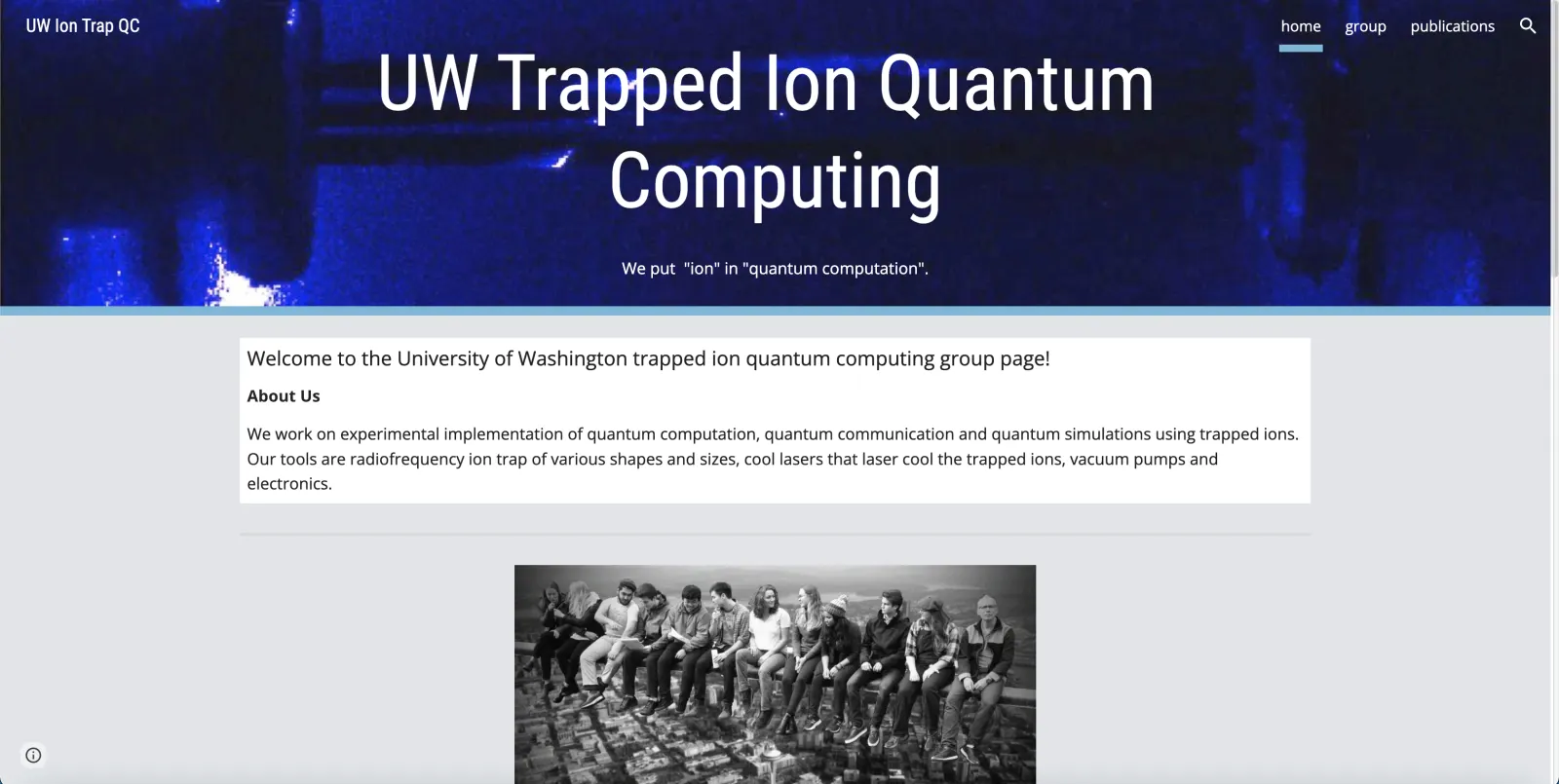
  • Screenshot of the University of Washington Trapped Ion Quantum Computing group homepage.

    Jan 2020 – Aug 2021

    Trapped-ion instrument control and Doppler cooling

    University of Washington — Trapped Ion Quantum Computing Laboratory

    • Undergraduate researcher. Python GUI + NI-DAQ for real-time instrument control; simulate Paul traps; built/calibrated ion-trapping apparatus; two-tone Doppler cooling; co-authored Phys. Rev. A 2022.
    • University of Washington, Trapped Ion Quantum Computing Laboratory (January 2020 – August 2021). The research group adapted pyLIon, an open-source molecular-dynamics simulator for trapped ions originally developed at the University of Oxford, to the laboratory's own trap configuration.

Section 03

Publications

  1. 01

    H. Yao, N. Yin, R. Lee, G. Liu, and F. Renzoni, “Through-Barrier Sub-mm Electromagnetic Induction Imaging With Atomic Magnetometers,” IEEE Transactions on Instrumentation and Measurement, vol. 74, Art. no. 4506708, 2025. Published 19 March 2025. doi:10.1109/TIM.2025.3552880

    Eddy-current nondestructive testing is widely used for the detection of cracks and fatigue in metallic structures. This is usually done by sweeping an inductor coil over the sample of interest while monitoring changes in the coil response. While this may allow for the detection of sub-mm cracks and defects, the technique lacks penetrating power through barriers. This work addresses such capability gaps. We demonstrate a mechanically translatable system based on an atomic magnetometer (AM) that allows for sub-mm resolution while simultaneously allowing also for penetration through shields. The adoption of a radio frequency (RF) AM as a sensor allows for the operation of the system at low frequency, with high sensitivity achieved by introducing several technical solutions, which lead to enhanced performances, with respect to existing systems, and improved stability of the instrument while scanning over the target object. The obtained enhanced performances are highlighted by the demonstrated ability to detect and image gaps as small as 0.27 mm concealed behind a shield consisting of a 1.50-mm rubber sheet and a 0.42-mm aluminum sheet.

  2. 02

    A. Kato, A. Goel, R. Lee, Z. Ye, S. Karki, J. J. Liu, A. Nomerotski, B. B. Blinov, 'Two-tone Doppler cooling of radial two-dimensional crystals in a radio-frequency ion trap,' Phys. Rev. A 105(2), 023101 (Feb 2022)

    We study the Doppler-cooling of radial two-dimensional (2D) Coulomb crystals of trapped barium ions in a radiofrequency trap. Ions in radial 2D crystals experience micromotion of an amplitude that increases linearly with the distance from the trap center, leading to a position-dependent frequency modulation of laser light in each ion's rest frame. We use two tones of Doppler-cooling laser light separated by approximately 100 MHz to efficiently cool distinct regions in the crystals with differing amplitudes of micromotion. This technique allows us to trap and cool more than 50 ions populating four shells in a radial 2D crystal, where with a single tone of Doppler cooling light we are limited to 30 ions in three shells. We also individually characterize the micromotion of all ions within the crystals and use this information to locate the center of the trap and to determine the Mathieu parameters qx and qy.

Section 04

Posters

  1. Poster

    Structure and Dynamics Investigation of Barium Hydrogen Phosphate (BaHPO4)

    23rd UW Undergraduate Research Symposium

    Here, we utilize incoherent Quasi-Elastic Neutron Scattering (QENS). QENS is a useful technique to determine diffusive motions in the 10−12 to 10−9 second time range at length scales from 3 Å to 60 Å, which apply to hydrogen ion diffusion and hydrogenous species. Protons have a substantial neutron cross section, which subsequently enhances the associated QENS signal, and permits studies of low-proton systems such as BaHPO4. The QENS investigation was conducted using 7 discrete temperatures ranging from 293 to 573 Kelvin, while subsequent fitting and analysis revealed the diffusion coefficient as a function of temperature. Obtained results for BaHPO4 were compared to Monetite (CaHPO4). In addition to QENS, data from Neutron Powder Diffraction (NPD) using Linear Position Sensitive Detector (LPSD) was analyzed to further comprehend the crystal structure of BaHPO4 and to check its consistency. Lastly, images from Scanning Electron Microscopy (SEM) and Atomic Force Microscopy (AFM) provided support by giving insight to the surface topography of the sample to allow us to analyze the feasibility of BaHPO4 as potential application for other fields.

Section 05

Education

  1. 2022–2023

    M.S. Quantum Technologies

    University College London

  2. 2017–2021

    B.S. Physics

    University of Washington

  3. 2025–Present

    Dual major Mechanical Engineering & Computer Science

    Texas State University

    In progress · expected 2028

Section 06

Skills

  • Languages

    • Python
    • C++
    • Java
    • JavaScript
    • HTML/CSS
    • SQL
  • Tools

    • LabVIEW
    • NI-DAQ/nidaq
    • Git
    • VS Code
    • LaTeX
  • Laboratory

    • atomic magnetometers
    • laser spectroscopy
    • SEM
    • XRD
    • QENS
    • instrument-control GUIs

Section 07

Contact

Targeting instrumentation, test, and research-engineering roles in aerospace, defense, sensing, and related R&D.

Austin, TX area